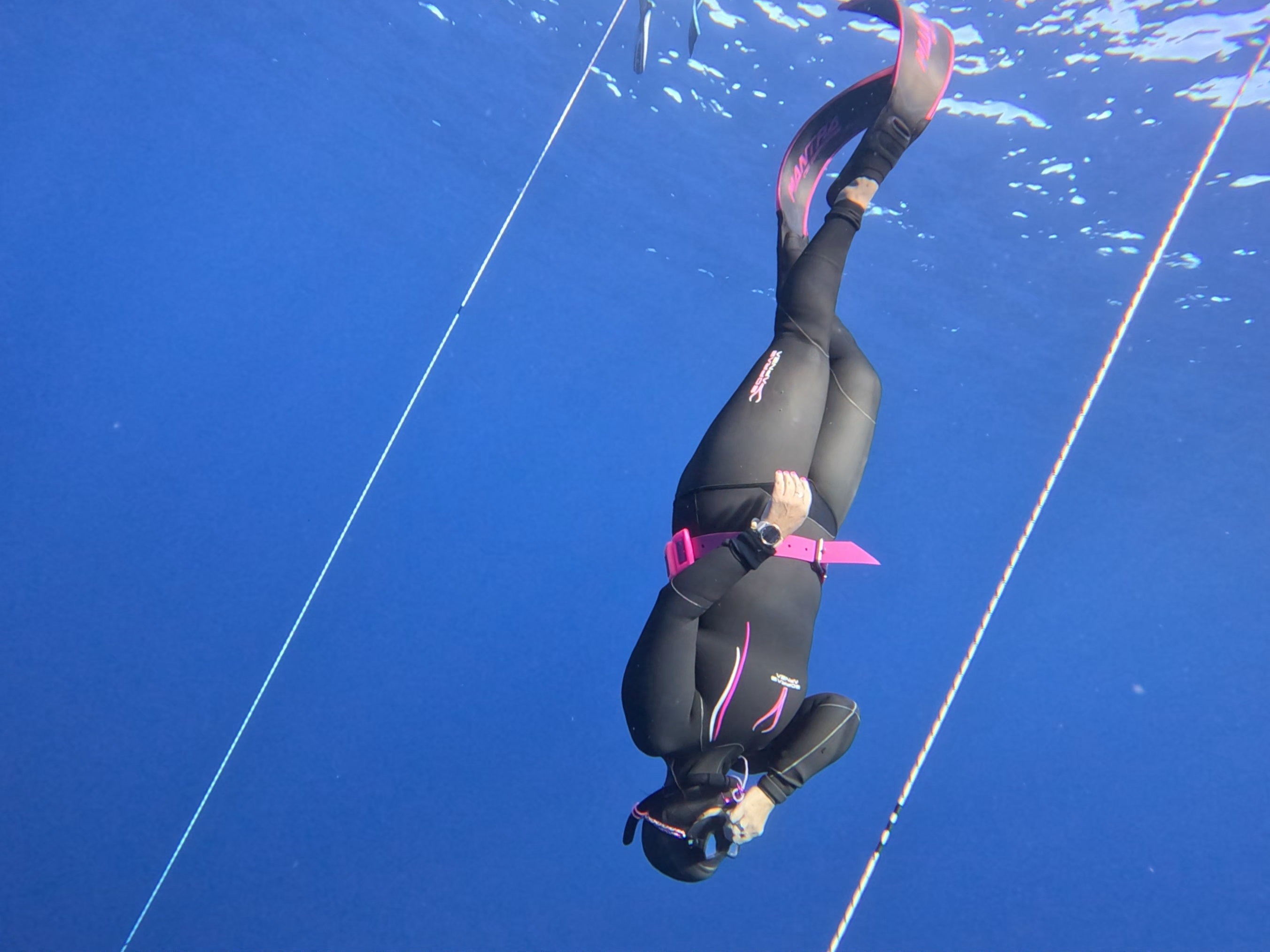
01 / THE HUMAN QUESTION
The Unexpected Mental Health Gifts of Freediving
The ocean gave me calm, but it also gave me contrast—and showed me parts of my nervous system I thought I already understood.
Sure, we can talk about cortisol, breathing, parasympathetic activity, and why cold-face immersion can slow the heart rate. We already know physiology matters in freediving. Most of us encounter some version of the mammalian dive response in our first freediving course (Kinoshita et al., 2006; Panneton, 2013).
But when I started freediving, I wanted to know something else.
Why did I feel like a radically different person in the water?
Why did my brain become so quiet?
Why did there seem to be a pause—a moment when the noise dropped and I felt, somehow, more like myself than I often did on land?
And why, for a day or sometimes longer after diving, did I seem to have greater access to feeling good?
My life was not necessarily bad. I exercised. I lifted weights. I danced. I walked. I had plenty of activities that made me feel better.
Freediving felt different.
At first, I assumed the answer was breath-holding.
Freediving took my breath away. Literally. Cute explanation. Not sufficient.
When I began investigating the question more seriously in 2023, I realized that breath-holding was only one part of the experience. Add water, immersion, pressure, sensory change, interoception, another nervous system on the float, and the mammalian dive response, and suddenly something much more interesting is happening.
What fascinated me was how closely some of the physiology I was studying in freediving intersected with questions I had spent years asking in mental health and trauma work.
That felt a little like kismet.
I had spent years working in mental health and public health, and trauma therapy had increasingly become one of my specialties. My own complicated experience with adversity also gave me another vantage point—not a better one, but one that made certain discrepancies difficult for me to ignore.
Because I thought I had done the work.
I was a therapist. I ran a private practice. I taught at a university. I had spent years learning about relationships, trauma, behavior, recovery, and nervous system regulation.
And then I got on a freediving float and sometimes felt like I had no idea who I was.
That was not one of the gifts I had been expecting.
There were moments when my responses felt strangely young, vulnerable, disproportionate, or unfamiliar. I could manage complex decisions on land and then become overwhelmed by something seemingly simple in the water.
I remember thinking: Why don’t I know better?
Why is this so hard?
Why am I crying on a float?
Who cries on a freediving float?
For a while, I thought something was wrong with me.
What I eventually understood was more interesting.
Land had allowed me to function around certain patterns. The water made some of them easier to feel.
That distinction changed the direction of my work.
MENTAL HEALTH IS NOT JUST WHAT HAPPENS IN THE MIND
Depression, anxiety, and post-traumatic stress are given names because naming patterns helps clinicians communicate, diagnose, study, and treat them. But the lived experience is rarely confined to thought.
Mental health shows up in breath, posture, muscle tone, digestion, attention, motivation, voice, movement, perception, sleep, social connection, and the ability to engage with the world.
Current neuroscience increasingly describes the brain and body as dynamically coupled rather than separate systems. Interoception—the detection, interpretation, and integration of internal bodily signals—plays an important role in emotion, perception, behavior, and a range of mental health conditions (Greenwood & Garfinkel, 2025; Nord & Garfinkel, 2022).
That matters because depression is not simply sadness.
Anxiety is not simply worry.
Post-traumatic stress is not simply remembering something terrible.
These experiences can involve changes in the way we interpret body signals, allocate attention and energy, anticipate threat, engage with the environment, and recover after challenge (Nord & Garfinkel, 2022; Porges, 2017).
People also become extraordinarily good at functioning around difficult internal states.
We stay busy.
We overperform.
We accommodate.
We withdraw.
We scroll.
We sleep.
We stop calling friends.
We stare at a pile of dishes and cannot quite initiate the movement required to wash them.
We become intensely productive or almost completely still.
Professionally, we have elegant language for many of these patterns.
Inside the body, however, the experience is often far less elegant.
It is physiology trying to manage load.
In Behind the Mask, I define mental health this way:
Mental health is the capacity of the nervous system to respond flexibly to stress, recover after challenges, and remain connected to self and others in a meaningful way. It’s not a fixed trait—it’s a reflection of how well we can regulate, relate, and return to baseline across a range of experiences. (Hicks, 2025)
Mental health is not about always being calm.
It is about knowing something about the state you are in, having enough access to your internal signals to understand what that state may require, and developing the flexibility to move when movement is possible or needed.
Social media has done regulation no favors. We are frequently sold the idea that a “regulated” nervous system is permanently serene, unbothered, breathing slowly, and apparently living beside a beige throw pillow.
Human nervous systems are not supposed to remain in one state.
They are supposed to move.
THE BODY IS CONSTANTLY SENDING INFORMATION
Internal cues do not sit passively in the background. Heartbeat, respiration, muscular tension, gut sensation, temperature, pain, fatigue, and other bodily information contribute to emotion, perception, decision-making, and behavior (Greenwood & Garfinkel, 2025; Nord & Garfinkel, 2022).
Problems can emerge when those internal signals become difficult to detect, overwhelming to interpret, repeatedly predicted as dangerous, or disconnected from the meaning we assign to them.
Some people become less connected to bodily information.
Others become exquisitely attentive to every internal fluctuation.
Neither pattern explains every case of depression or anxiety, and the relationship is far more complex than a simple “too much” versus “too little” model. Still, the contrast is useful.
Some depressive states can include blunted interoceptive processing, emotional numbing, withdrawal, and reduced engagement. Anxiety can include heightened monitoring of internal sensations and a tendency to interpret ordinary physiological changes as evidence that something is wrong (Nord & Garfinkel, 2022).
One system may seem to say: Stop.
Another may seem to say: Something is coming. Get ready.
These are not character flaws. They are embodied patterns worthy of curiosity.
And this is where freediving became particularly interesting to me.
THEN ADD WATER
Freediving gives us an unusual laboratory for observing discrepancies between what the brain expects and what the body is signaling.
The moment we enter the water, conditions change.
Breathing changes.
Pressure changes.
Sensory information changes.
Heart rate changes.
Blood flow changes.
Attention changes.
During apnea and facial immersion, the mammalian dive response initiates a coordinated oxygen-conservation response that includes bradycardia, peripheral vasoconstriction, and other cardiovascular adaptations (Panneton, 2013). Cold-face immersion itself can increase cardiac parasympathetic activity and slow heart rate (Kinoshita et al., 2006).
Breath practices also influence autonomic activity and have been studied in relation to stress, depression, trauma, and emotional regulation (Gerbarg et al., 2019).
None of this means the mammalian dive response magically treats depression, anxiety, or trauma.
But the dive response changes the physiological conditions.
And changing the conditions creates contrast.
Contrast can reveal information.
You may not realize how tense your shoulders were until they soften.
You may not recognize how much you have been monitoring the environment until your gaze changes.
You may not understand how much effort “I’m fine” requires until some of that effort briefly disappears.
You may believe you are calm until stillness itself becomes uncomfortable.
That is where I began thinking about what I now call physiological honesty.
Does the state of my body match the story I am telling myself about how I am doing?
Sometimes the answer is yes.
Sometimes the answer is absolutely not.
THE OCEAN IS A REGULATOR—AND A REVEALER
We talk frequently about the beautiful side of freediving.
Peace.
Awe.
Connection.
Silence.
Trust.
The feeling of becoming weightless.
Those experiences are real.
In the exploratory survey of 120 freedivers that I report in Behind the Mask, 85% of participants reported meaningful positive changes in self-concept after consistent freediving practice. Ninety-seven percent reported positive emotional states after diving, including joy, relief, calm, and awe. Seventy-four percent described a stronger sense of trust and belonging in the freediving community (Hicks, 2025).
Those are significant findings, but they are self-reported observations from an exploratory study—not proof that freediving is a mental health treatment.
And they are not the only mental health gifts of freediving.
The water can also amplify what the nervous system is already carrying.
For some divers, quiet creates relief.
For others, quiet leaves enough room for intrusive thoughts to become louder.
One diver experiences pressure as containment; another experiences the same pressure as threat.
One person becomes less self-conscious underwater; another suddenly becomes intensely aware of failure, performance, or being watched.
Breath-holding can become a meaningful practice of regulation and awareness, but freediving can also become another place where people override internal signals, chase intensity, compulsively pursue performance, or depend upon the dive state to access feelings they struggle to reach elsewhere.
Hypervigilance may look like preparation.
Self-criticism may masquerade as discipline.
Over-accommodation may look like being an easy student or an agreeable buddy.
An early turn may be interpreted as failure when the nervous system is actually communicating something important.
None of those observations require us to pathologize freedivers.
Quite the opposite.
Nervous system literacy allows us to become curious about behavior before assigning moral meaning to it.
A difficult dive becomes data. A sudden state shift becomes information. The question changes from “What is wrong with me?” to “What happened in my system?”
That was one of the most important mental health gifts freediving gave me.
THE FREEDIVER’S PARADOX
Freediving can create extraordinary calm and connection while simultaneously exposing unresolved patterns of stress, protection, and adaptation.
That is the freediver’s paradox.
The ocean can regulate us and reveal us.
And sometimes the revelation is not particularly flattering.
I thought I had my shit together.
In many ways, I did.
What freediving showed me was that competence and recovery are not identical.
I had developed an adult life capable of carrying enormous responsibility. I could think analytically, care for other people, solve problems, teach, research, and work.
Then the water occasionally introduced me to responses that felt much older than the competent adult standing on shore.
Nobody around me could adequately explain what I was experiencing.
So I started studying it.
I began placing freediving physiology beside trauma physiology. I looked at interoception, neuroception, autonomic regulation, relational safety, cranial nerves, breath, pressure, co-regulation, and the mammalian dive response.
Slowly, what had initially felt like proof that something was wrong with me began to look like information I had never had access to before.
And that may be one of freediving’s most unexpected gifts.
Not simply feeling better.
Seeing more accurately.
Because better mental health does not always begin with becoming calm.
Sometimes it begins when the nervous system gives us enough contrast to recognize what we have been carrying.
The ocean did not erase those truths for me.
It amplified them.
And somewhere inside that amplification was the opportunity for awareness, regulation, connection, and eventually greater choice.
Maybe that is what I meant years ago when I scribbled a sentence into the notes for a talk:
Perhaps we have a lot to learn about physiological honesty.
I think I am still learning.
That question became the foundation of my work on freediving and mental health. What follows is the science, research, and nervous-system framework that helped me begin making sense of what the water was showing me.
References
Gerbarg, P. L., Brown, R. P., Streeter, C. C., Katzman, M., & Vermani, M. (2019). Breath practices for survivor and caregiver stress, depression, and post-traumatic stress disorder: Connection, co-regulation, compassion. OBM Integrative and Complementary Medicine, 4(3). https://doi.org/10.21926/obm.icm.1903045
Greenwood, B. M., & Garfinkel, S. N. (2025). Interoceptive mechanisms and emotional processing. Annual Review of Psychology, 76, 59–86. https://doi.org/10.1146/annurev-psych-020924-125202
Hicks, E. (2025). Behind the mask: A freediver’s guide to nervous system regulation, recovery & resilience. Somanautica Press.
Kinoshita, T., Nagata, S., Baba, R., Kohmoto, T., & Iwagaki, S. (2006). Cold-water face immersion per se elicits cardiac parasympathetic activity. Circulation Journal, 70(6), 773–776. https://doi.org/10.1253/circj.70.773
Nord, C. L., & Garfinkel, S. N. (2022). Interoceptive pathways to understand and treat mental health conditions. Trends in Cognitive Sciences, 26(6), 499–513. https://doi.org/10.1016/j.tics.2022.03.004
Panneton, W. M. (2013). The mammalian diving response: An enigmatic reflex to preserve life? Physiology, 28(5), 284–297. https://doi.org/10.1152/physiol.00020.2013
Porges, S. W. (2017). The pocket guide to the polyvagal theory: The transformative power of feeling safe. W. W. Norton & Company.